The Biggest Shift in DJ Tech Since the Sync Button
Stem separation is pushing DJing into a new era of improvisation and hybrid performance. How this technology is going to reshape DJing as we know it.
7 minutes read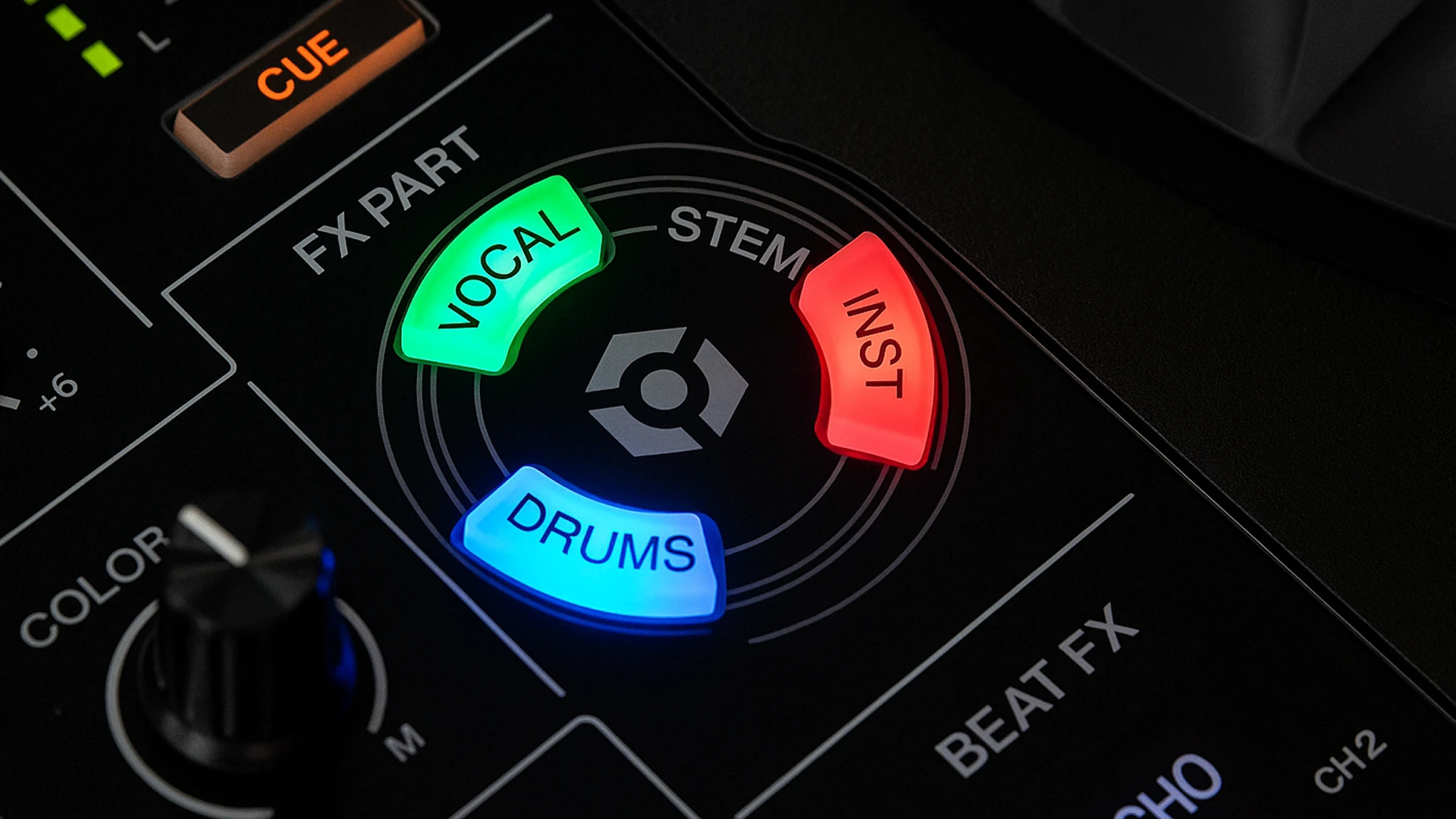
For decades, DJing has been defined by a simple premise: two tracks, one mixer, infinite interpretation.
A culture built on transition, selection, flow, and the intimate chemistry between tracks chosen at the right moment.
But in the last two years, a quiet revolution has been unfolding, not on festival stages or in club basements, but in bedrooms, YouTube channels, livestream studios, and the rapidly evolving ecosystems of DJ software.
A revolution built on stem separation: the ability to split a song into its constituent parts: vocals, drums, bass, melody and manipulate them live.
What began as a glitchy experiment is maturing into a stable, expressive tool.
What began as novelty software trickery is becoming a mainstream DJ expectation.
And what began as a technological possibility is becoming a cultural shift.
A new era is arriving, and it’s redefining what DJing is.
Some call it liberation.
Some call it chaos.
Some call it unnecessary.
But everyone can feel it:
DJing has entered its first evolutionary phase in a decade and this time, the change is coming from within the craft itself.
The Beginning of a New Mental Model
Until recently, DJs viewed tracks as closed forms, complete statements.
Your job was to interpret them, blend them, weave them, respect them.
Stem separation blows this open.
Suddenly, a track becomes raw material.
A canvas.
A skeleton.
A starting point rather than an endpoint.
When you think in stems, you stop mixing tracks. You start mixing possibilities.
- Kaden Flux (a DJ based in Amsterdam)
Instead of asking, “What track fits next?”
DJs are asking:
What if the vocals travel somewhere else?
What if the melody floats over a darker groove?
What if the drums collapse into silence?
What if I rebuild the track from scratch, one layer at a time?
The booth becomes a place of editing rather than blending.
It becomes a creative environment, not just a selection environment.
The implications will bechanging.
The Hybridisation of the DJ
As stems gain traction, DJs are suddenly entering a space long reserved for live performers and producers: real-time deconstruction.
You’re no longer simply choosing the right record.
You’re reshaping records to create moments that never existed before.
With stems, you’re not just playing tracks, you’re sculpting energy.
- Tess Calder (a DJ based in London)
This is why stems-heavy DJs look different.
They move differently.
They think faster.
Their sets have a level of micro-editing that feels almost improvised.
It’s not a pre-planned edit.
It’s not a track someone else made.
It’s not a bootleg.
It’s the DJ creating a moment in real time.
And it’s changing how crowds respond.
Crowds Will Hear the Difference, Even If They Don’t Understand It
When a DJ suddenly isolates a vocal everyone knows and floats it over a completely unexpected drum pattern, the reaction is physical.
It feels like surprise.
It feels like authorship.
It feels like electricity.
The audience doesn’t need to know how a DJ is doing it.
They can feel that something unusual is happening.
This unpredictability is rare in recent DJ culture, where many sets rely on safe blends, harmonic compatibility, and predictably structured tracks built for streaming.
Stems bring back surprise, danger, and the sense that a set can truly go somewhere unexpected.
A New Sonic Aesthetic Is Emerging
Because stem separation allows DJs to pull tracks apart, producers are beginning to put them together differently.
You can already hear shifts in production:
Basslines are cleaner and more isolated
Vocals are mixed with separation in mind
Drum groups are tighter
Melodies are less cluttered
Arrangements have more negative space
Producers are future-proofing their music for a world where DJs may remove or replace parts.
Tracks become more modular.
DJing becomes more modular.
The whole ecosystem evolves together.
Stems are Expanding Skill, Not Replacing It
Whenever DJ technology evolves, someone declares the craft dead.
Sync ruined DJing.
Digital libraries ruined crate digging.
Waveforms ruined phrasing.
Effects ruined subtlety.
Controllers ruined authenticity.
Laptops ruined presence.
Now stems are the new lightning rod.
But stems don’t replace DJ skill.
They multiply it.
To use stems well, you need:
Musical awareness, confidence, structural intuition, restraint, creativity, and the ability to manage chaos
It’s more thinking, not less.
More choices, not fewer.
More responsibility, not shortcuts.
Anyone can pull vocals out. Not everyone knows when not to.
- Theo Lyall (a DJ based in London)
Stems amplify personality, for better or worse.
The Stems DJ vs The Traditional DJ
A cultural divergence is taking place, not out of conflict, but out of evolution.
Two complementary DJ identities are emerging:
The Stems DJ
A live editor.
A manipulator.
A builder of spontaneous combinations.
Their sets are kinetic, nonlinear, energetic and often chaotic (in a good way).
The Traditional DJ
A curator.
A storyteller.
A master of pacing and emotional architecture.
Their sets are patient, deep, controlled. Focused on journey rather than spectacle.
Neither supersedes the other.
Neither form is “better.”
Both require skill, taste, and presence.
But they are different arts, and that difference is becoming clearer.
The New Language of the Dance Floor
Before stem separation, the expressive vocabulary of a DJ set was limited to:
track choice
blend timing
EQ
effects
tension & release
Now, the vocabulary includes:
silence of individual elements
recontextualised vocals
wholesale rhythmic shifts
melody relocation
spontaneous breakdowns
on-the-fly arrangements
It’s still DJing, but with new possibilities.
Lift the vocal.
Collapse the drums.
Melt the bass.
Flip the melody.
Freeze the groove.
Build the drop manually.
The DJ booth becomes a laboratory.
The set becomes a negotiation between what the crowd expects and what the DJ can invent.
The Emotional Shift: From Playback to Presence
In stems-heavy sets, the DJ’s presence becomes more visible.
Hands constantly moving, buttons constantly pressed, a feeling of physical engagement with the music.
This visual dynamism, intentionally or not, changes perception.
Crowds will feel like they’re watching something happen live, not just hearing records, but witnessing performance.
It closes the psychological distance between DJ and audience.
I feel like I'm inside the track. Not just playing it, but shaping it. It feels alive.
- Ewen Richter (a DJ based in Liverpool)
That sense of aliveness is the core of what to expect in the stem separation era of DJing.
Stems and the New Rules of Restraint
But here’s the twist: stem separation doesn't just enable maximalism, it rewards restraint.
Some of the most powerful moments are subtle:
A vocal teased for half a bar.
The drums disappearing for two seconds.
A melody held back like breath.
A bassline appearing at an unexpected moment.
Stem separation gives DJs access to a palette that demands taste, not constant activity.
The best stems DJs aren’t hyperactive, they’re intentional.
The Psychological Shift for DJs
Stems also impact the identity of a DJ.
For years, DJs defined themselves by:
Selection, research, crates, curation, and the emotional arc.
Now, new markers emerge:
Ability to recombine, sense of rhythm in deconstruction, improvisational instinct, timing of element-level changes, and crowd-reading through manipulated layers.
DJs must ask themselves:
Am I a selector? An editor? A performer? A manipulator of tension? Or a builder of unexpected collisions?
Identity becomes fluid, and fluidity becomes a strength.
What This Means for Dance Music
Stems won’t replace traditional DJing.
But they will reshape the landscape.
We’re at the start of a new era where:
DJ sets contain moments that can’t exist in tracks
Producers design music for rearrangement
Crowds expect some level of live reinterpretation
DJs differentiate themselves through manipulation, not just curation
Most importantly, stems bring back a feeling that had been slipping away: risk.
Something could go wrong. Something could go right. Something could happen that has never happened before.
And dance music thrives on that.
So What Comes Next?
Three trajectories seem likely:
1. A generation of DJs will become hybrid performers.
Neither DJs nor live acts, something in between.
2. Stem separation-influenced production will expand.
Tracks will be built with more modularity in mind.
3. DJ sets will increasingly contain “unreproducible moments.”
Personal, unrecorded combinations that vanish after the night.
This is perhaps the most beautiful possibility.
The Return of the Unrepeatable.
In an age where everything is recorded, replayed, clipped, shared, and archived, stem separation creates moments that cannot be recreated the same way twice.
Moments that live only in the room. Only with that crowd. Only with that DJ. Only in that instant.
Dance music needs that. Culture needs that. We all need that.
And stems, for all the anxiety, excitement, and debate, bring it back.
DJing hasn’t been devalued or automated. It’s been reopened.
Split at the source. Richer at the surface. More alive than it has been in years.