One Night, Five Spaces: What Dance Music Sounds Like Right Now
From basements to after-hours apartments, one night across five spaces reveals what dance music really sounds like right now.
4 minutes read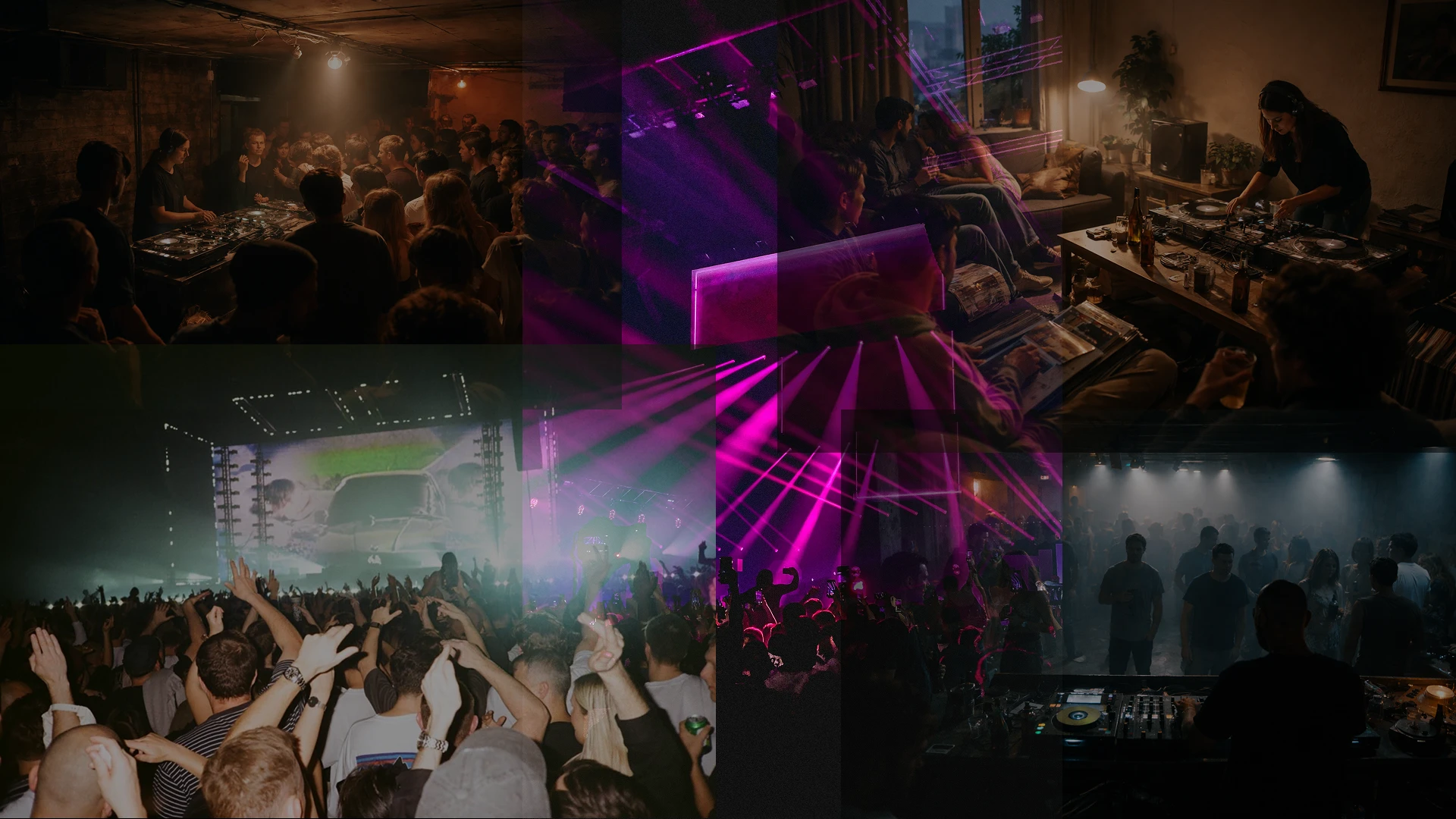
It’s easy to talk about dance music as a single culture.
It’s much harder to capture how fragmented and how alive it actually is.
On any given weekend night, dance music isn’t moving in one direction. It’s splintering, overlapping, contradicting itself. Different spaces are chasing different energies, speaking to different crowds, responding to different pressures.
To understand what dance music really sounds like right now, you don’t need charts or trend forecasts. You need to be where it's happening.
So here’s one night, five spaces, five moods, five versions of the same culture happening at once.
One: The Community Basement
It’s just after 11pm. The room is already warm.
The ceiling is low, the lighting minimal, the sound system dialled in but not aggressive. There’s no stage, the DJ is at floor level, almost swallowed by the crowd. Most people seem to know each other, or at least recognise each other.
The music is patient. Grooves stretch. Tracks take time to reveal themselves. When a familiar chord progression drifts through the mix, there’s a quiet collective response; not screaming, not phones in the air, just a subtle tightening of focus.
This room isn’t trying to impress anyone.
It’s trying to hold people.
Here, dance music feels like a social fabric rather than a product. The DJ isn’t performing upward, toward visibility; they’re performing inward, toward trust. Risk is allowed because the crowd feels invested in the journey, not just the payoff.
If there’s a future being built here, it’s slow, relational, and deeply local.
Two: The Hybrid Warehouse
By midnight, the warehouse is heaving.
This is a larger space: industrial, semi-legal, with lighting that moves between precision and chaos. The crowd is younger, more stylistically mixed. You see fashion statements, not uniforms.
The music is faster here. BPMs creep upward. Genres blur. Techno bleeds into trance, trance fractures into something harder, more distorted. Drops arrive, but they don’t resolve cleanly. Tension is the point.
This room feels wired into the internet.
You can hear references to viral edits, to online micro-scenes, to moments that live half their life on screens. But there’s also resistance. The DJ pulls back just as often as they push forward.
People film, but not constantly. The phones come out in bursts, then disappear. The crowd seems to want both presence and proof.
This is dance music negotiating its relationship with speed, attention, and identity. Live, unresolved, and slightly volatile.
Three: The Polished Club Night
At 1:30am, the club feels pristine.
Everything is calibrated: lighting cues hit on time, visuals are clean, the sound is loud but controlled. The DJ booth is elevated. The lineup has been promoted for weeks. People arrived knowing what they were going to get.
The music is efficient.
Big moments land quickly.
Transitions are smooth, predictable, satisfying.
This room runs on momentum. It’s designed for a crowd that wants reassurance, a night that delivers exactly what it promised. The energy is high, but contained. There’s little friction.
Nothing here is bad.
Nothing here is surprising.
This is dance music as professional entertainment: reliable, scalable, exportable. It reflects an industry that has learned how to reduce risk, optimise experience, and avoid alienation.
You leave knowing you had a good night, but not necessarily a memorable one.
Four: The After-Hours Apartment
It’s nearly 4am when the apartment fills up.
Shoes pile by the door. Someone is rolling a cigarette near an open window. The DJ setup is improvised, a controller balanced on a table, speakers not quite meant for this purpose. The lighting is whatever’s left on.
The music drifts.
Old tracks appear unexpectedly.
Genres collapse into mood rather than structure.
There’s no pressure here. No one is documenting. The dance floor dissolves into conversations, then reforms. People take turns playing records or files they love rather than tracks they trust.
This room exists outside the industry entirely.
Here, dance music feels private again, a language between friends, a way to extend the night without performing it. It’s messy, uneven, sometimes boring, sometimes magical.
It reminds you that not all meaningful dance music moments are designed to scale.
Five: The Closing Hour
By 6am, only a few remain.
The lights come up slightly. The DJ plays slower, deeper, more introspective tracks. The crowd thins, but those who stay are fully present. There’s a sense of quiet achievement, not triumph, but completion.
This is the hour most people never see.
Here, dance music stops trying to convince anyone of its value. It simply exists. The room feels honest in a way earlier hours can’t.
What These Spaces Reveal
Taken together, these spaces tell a simple truth:
dance music is not unified and that’s not a problem.
Some spaces prioritise community.
Some chase speed and novelty.
Some deliver professionalism.
Some exist purely for intimacy.
What’s changed is not the diversity, it’s the lack of a single dominant narrative. Not one space defines the culture anymore.
And maybe that’s the most accurate reflection of where dance music is right now:
fragmented, contradictory, alive.
The future isn’t in choosing which space wins.
It’s in understanding why all of them exist and what each one is responding to.
On any given night, dance music sounds like all of this at once.